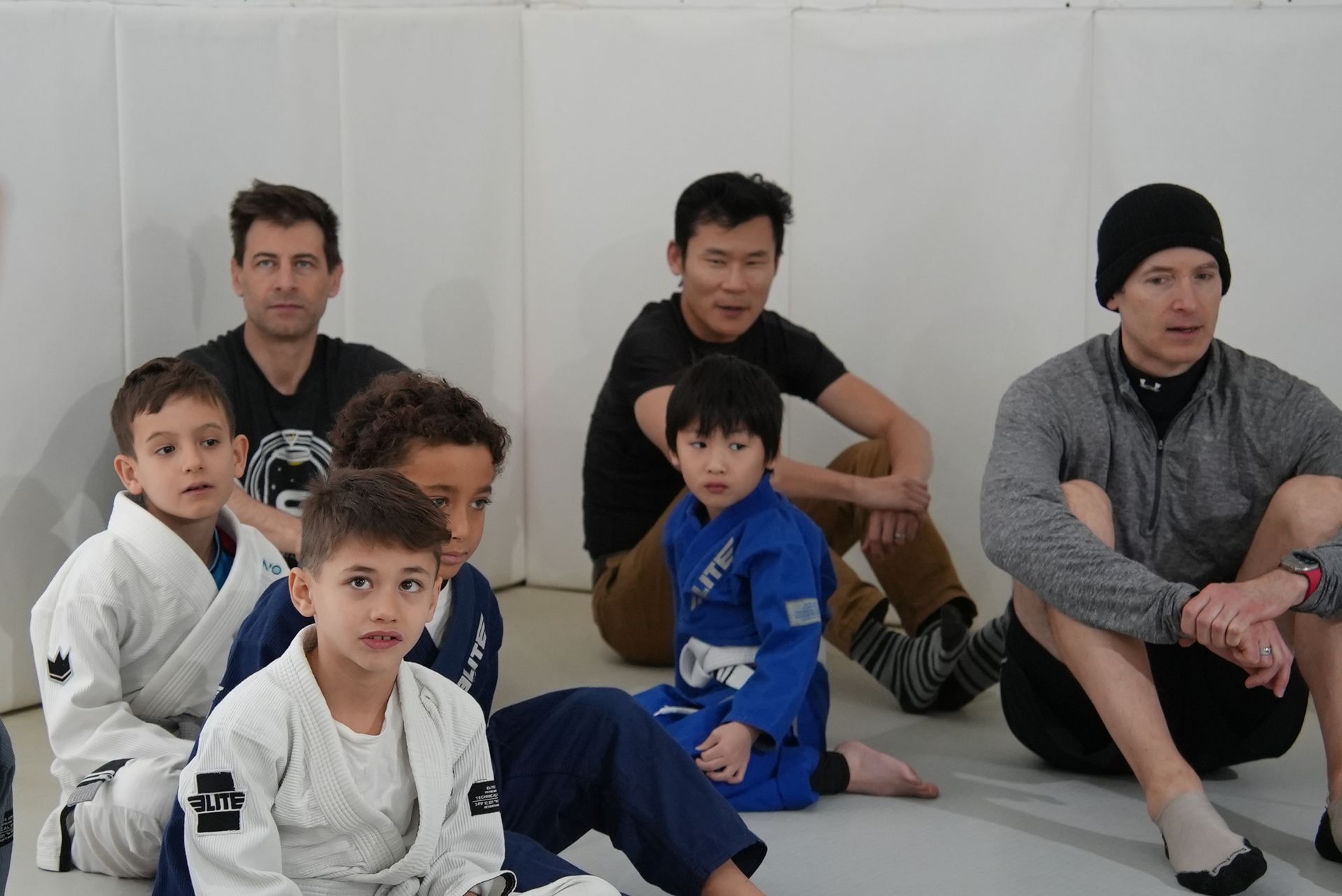
A consistent class routine can turn a busy Manhattan week into something your whole family shares and talks about.
New York schedules can feel like a puzzle you never quite finish. School, work, homework, screens, and commutes all compete for attention, and even when you care deeply about family time, it can get squeezed into the margins. Youth Brazilian Jiu-Jitsu gives many families a practical way to rebuild that time, not with a huge production, but with a steady rhythm you can actually keep.
In our kids classes, you will see something that surprises a lot of parents: the bonding does not come from parents coaching on the sidelines or kids “performing” for adults. It comes from a shared routine, shared language, and shared milestones. When kids learn how to handle pressure calmly on the mat, families often find it’s easier to talk through pressure off the mat too.
This article breaks down how Youth Brazilian Jiu-Jitsu can support stronger family connection in NYC, what age-appropriate coaching really looks like, and how we keep training focused on fundamentals and safety so your child can learn with confidence.
What Youth Brazilian Jiu-Jitsu teaches beyond technique
Brazilian Jiu-Jitsu is a grappling art built around leverage, positioning, and control rather than relying primarily on strikes or raw strength. For kids, that matters because it means progress is not reserved for “the biggest” or “the most athletic.” A child can improve simply by learning where to place hands and feet, how to move their hips, and how to stay composed long enough to think.
In Youth Brazilian Jiu-Jitsu in New York, the skills kids practice are very concrete. They learn how to listen, try, reset, and try again. They learn to partner up, follow rules, and treat training partners with respect. And because BJJ is hands-on, it naturally teaches boundaries: how to work with another person safely, how to slow down, and how to stop immediately when a partner taps.
A lot of families also appreciate that class has structure. There is a beginning, a middle, and an end. There are clear expectations for behavior. Kids can be energetic, shy, silly, serious, or all of the above in the same week, and the class framework still holds. That structure is one of the quiet reasons Youth Brazilian Jiu-Jitsu can be such a steadying presence for families in the city.
Six ways training can strengthen family bonds in NYC
1. A shared routine that is easier to protect than “free time”
Unstructured family time sounds great, but NYC has a way of eating it. A weekly class is different: it is on the calendar, it has a start time, and it becomes part of the family’s normal flow. Packing the uniform, filling the water bottle, and walking in together creates small moments of connection that add up over months.
Many families also find that the routine cuts down on after-school friction. Instead of negotiating what happens next every day, you have at least one dependable anchor in the week. Youth Brazilian Jiu-Jitsu can become that anchor without requiring an all-day commitment.
2. Better parent-child conversations (because you finally have something specific to ask)
“Did you have a good day?” often gets a shrug. BJJ gives you better prompts because kids are learning tangible skills and encountering normal setbacks. You can ask about a position, a drill, or what felt tricky. And because progress is measured in small steps, your child can give you real answers.
Here are a few questions that tend to get more than one-word responses:
- What was one thing you improved today, even a little?
- What felt confusing, and what helped it click?
- Who did you work with, and how did you help your partner?
- What do you want to practice again next class?
- Did you remember to breathe and stay calm when something got hard?
Those conversations may seem simple, but over time they create a shared language between you and your child. That shared language is a big reason Youth Brazilian Jiu-Jitsu in New York can feel like a family activity even when parents are not training on the mat.
3. Mutual encouragement that focuses on effort, not winning
BJJ has an honest feedback loop. Sometimes a technique works, sometimes it does not. Kids learn quickly that “trying hard” is important, but so is trying thoughtfully. When parents reinforce effort, attention, and persistence, children tend to feel supported without feeling evaluated.
We like to frame success in kid-friendly ways: showing up consistently, listening the first time, being a good partner, and staying respectful even when frustrated. Competition can be optional, and many kids thrive without ever needing to chase medals. For family bonding, that is huge, because the home conversation shifts from “Did you win?” to “Did you keep going?”
4. Emotional regulation under pressure, practiced safely
One of the most valuable parts of Youth Brazilian Jiu-Jitsu is that children practice staying calm while something is challenging. They might be pinned in a controlled drill and need to work step-by-step. They might feel nervous partnering up with someone new and learn to communicate anyway.
We do not frame this as a guaranteed psychological outcome. But many families report that the act of practicing calm decision-making, with clear rules and supervision, can support better emotional regulation in everyday situations. The mat becomes a place where kids can feel pressure, name it, and work through it, instead of melting down or shutting down.
5. Shared milestones that feel meaningful (even if your child never competes)
Families love milestones because they mark growth. In BJJ, milestones show up in lots of ways: your child’s first class, first stripe, learning how to shrimp smoothly, remembering to tap, or helping a newer student feel welcome.
What makes these milestones family-bonding moments is that you get to celebrate what your child earned through repetition. Not perfection, not talent, just consistent work. That kind of progress tends to feel sturdy, and kids know the difference.
6. Independence without disconnect
In class, kids learn to step onto the mat without you doing it for them. At the same time, you are still present as their steady support. That balance is powerful, especially in Manhattan where kids are often pushed toward independence early. Youth Brazilian Jiu-Jitsu can give children a structured place to practice autonomy while still feeling closely connected to you.
Why age-appropriate coaching matters, especially for younger kids
Kids are not small adults. A five-year-old needs different coaching than a nine-year-old, not just physically, but cognitively and emotionally too. Our children’s programs are separated into age-based levels so instruction can reflect students’ physical, cognitive, and emotional development. That separation helps us keep expectations realistic and keep training fun, focused, and safe.
For ages 5 to 9, our Little Warriors program emphasizes respect, discipline, patience, teamwork, and working through challenges. That may sound big for little kids, but the way we teach it is simple: lining up, listening, taking turns, using kind words with partners, and learning how to reset after a mistake. Over time, those habits become part of how kids show up at home too.
Age-appropriate training also helps with confidence. When kids are grouped well, they are more likely to feel capable, and that feeling can spill over into school, friendships, and family life. Youth Brazilian Jiu-Jitsu works best when children feel safe enough to try.
Safety, boundaries, and the way we keep training responsible
“Is it safe?” is usually the first question, and it should be. BJJ is a contact sport, so safety depends on coaching quality, supervision, rules, and the culture of the room. In our kids classes, we emphasize fundamentals and safety, and we take the details seriously because parents are trusting us with something important.
A few key safety practices we reinforce consistently include tapping and stopping immediately, controlled partner work, and clear expectations about intensity. We also focus on partner matching so kids can train in a way that fits their size, experience, and comfort level. When a child is nervous, we can scale things down. When a child is bursting with energy, we can channel it into structured drills.
Hygiene matters too. Clean uniforms, trimmed nails, and good mat habits reduce risk and make the space more comfortable for everyone. If you have ever tried to manage a kid’s after-school energy in a crowded city, you already know that comfort and predictability go a long way.
What your child’s first class may look like on the Upper East Side
First classes feel better when you know what to expect. Our academy is located at 328 East 61st Street, Ground Floor, New York, NY 10065, which makes it straightforward for many Upper East Side families to build training into the week without a complicated trip across town.
In a typical first class, you can expect a calm introduction to the space and the basic rules. Kids warm up with age-appropriate movement, then learn a technique or concept in a clear, step-by-step way. We usually spend time drilling with a partner so kids can practice safely with repetition. Depending on the class, there may be controlled games or positional exercises that let kids apply what they learned without turning the room into chaos.
If your child is shy or anxious, it is normal. Some kids jump in right away, others need a class or two to settle. We coach that process patiently. For many families, that first month is where the bonding starts, because you and your child are learning a new routine together.
Questions NYC parents ask about Youth Brazilian Jiu-Jitsu
What age can my child start?
Our Little Warriors program is designed for children ages 5 to 9. If your child is younger or older, our age-based structure helps us place students where coaching matches development, and you can confirm current options on the program pages.
Will my child need to compete?
Competition is optional. Many students train for skill-building, confidence, fitness, and community without competing. We define success in ways that make sense for kids: consistency, effort, focus, and respectful teamwork.
Does my child need to be athletic?
No. Youth Brazilian Jiu-Jitsu in New York works well for beginners with many different starting points. Because BJJ relies on leverage and positioning, kids can improve steadily through coaching and repetition.
Will BJJ make my child more aggressive?
Responsible training is the opposite of “get aggressive.” We emphasize respect, restraint, and consent. Kids learn to control intensity, stop when a partner taps, and use skills only in appropriate contexts.
How often should my child train?
Consistency matters more than intensity. A schedule should fit your child’s energy, schoolwork, and interest. If you want guidance, we can help you choose a frequency that feels sustainable rather than overwhelming.
Can parents train too?
We offer programming for children, adults, and families, which means multiple family members can be part of the same martial-arts community. Some parents like to train; others prefer to watch, support the routine, and learn the vocabulary so conversations at home feel more connected.
Simple ways to support progress at home without coaching from the couch
Parents sometimes feel pressure to “help” by giving technical advice. You do not need to do that. In fact, your best support often looks like consistency and calm encouragement.
Try these approaches for the first 90 days:
1. Keep gear simple and consistent so getting to class feels easy.
2. Praise specific effort like listening well, staying patient, and being a good partner.
3. Help your child reflect with one question after class instead of a full interrogation.
4. Encourage rest, hydration, and good food so training feels positive in the body.
5. Celebrate small wins like showing up on a tough day or trying again after a mistake.
When you support the process rather than the outcome, Youth Brazilian Jiu-Jitsu tends to become a source of connection instead of pressure.
Take the Next Step
Family bonding in NYC often happens in the small repeatable moments: walking to class together, seeing your child work through something challenging, and having a shared topic that is not school grades or screen time. Youth Brazilian Jiu-Jitsu can support those moments by giving your family routine, common goals, and a positive community that feels grounded and real.
At Range Brazilian Jiu-Jitsu NYC, we built our kids program to be family-centered and age-appropriate, with clear coaching, fundamentals-first instruction, and a strong emphasis on safety. If you want a structured activity that supports physical development and emotional growth without turning childhood into a nonstop competition, we are ready to help you get started.
Challenge yourself physically and mentally through consistent Jiu-Jitsu training at Range Brazilian Jiu-Jitsu NYC.